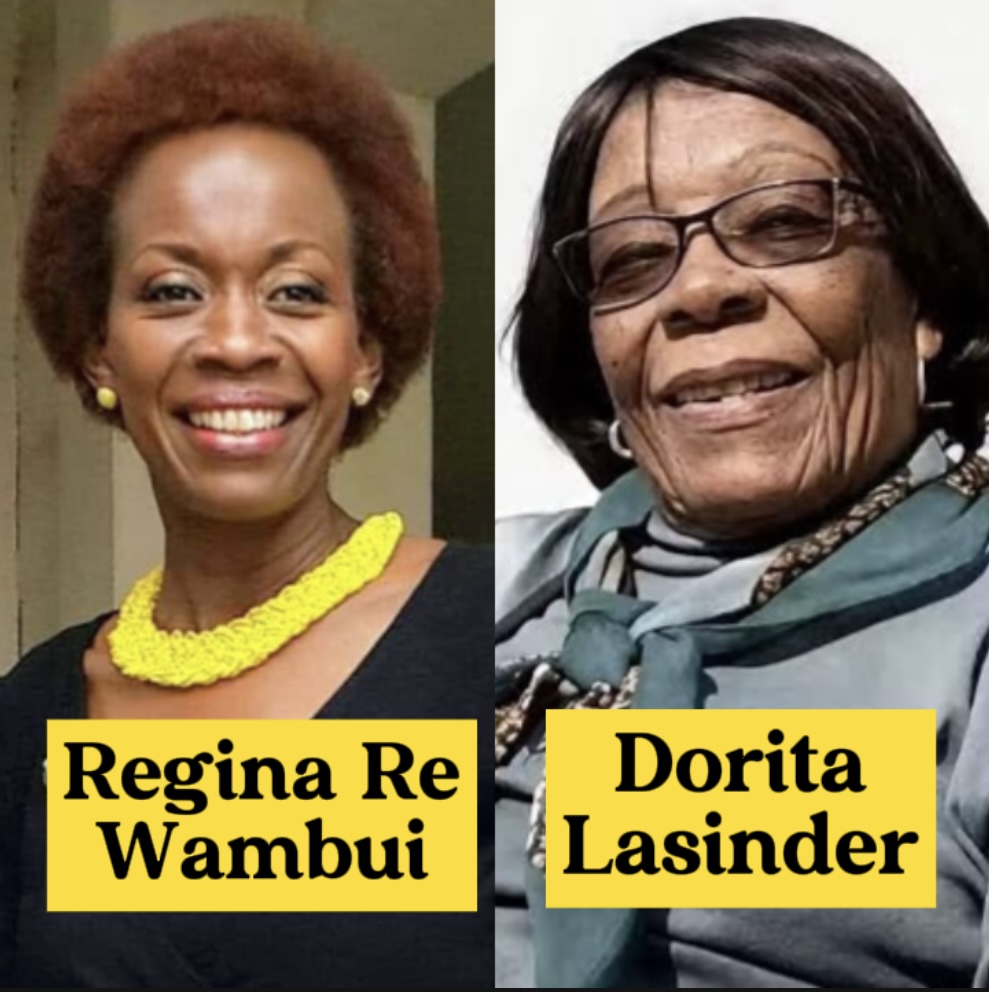
On the night of Friday, 30 October 2026, Dorita Lasinder Macharia, 86, was found dead in her home at Loresho Ridge Estate in Nairobi. She lay in a pool of blood. A government post-mortem conducted two days later by pathologist Dr Bernard Midia established that she had died from severe external bleeding caused by two deep stab wounds to the neck that severed major blood vessels.
The examination also recorded approximately twenty other sharp-force injuries across her face, neck, arms and body, together with a fractured arm. Midia noted that the instrument used was sharp enough to produce clean, deep cuts consistent with something more precise than an ordinary kitchen knife.
By Monday, 2 November, four people connected to the household had appeared at Kibera Law Courts: Dorita’s daughter, former KTN television presenter Regina Wambui Gitau (widely known as Regina Re); her granddaughter Thandie Malaika Wanjiku Gitao; Dorita’s son Antony (also referred to as Alton) Jimmy Macharia; and Immanuel Waigwe Munyeki. Detectives were granted ten days’ detention to complete their inquiries.
According to the investigating officer’s affidavit, the sequence began with an argument after Dorita allegedly found Thandie with her boyfriend in a bedroom and ordered the young people to leave. Thandie is said to have left, then returned, and remained in the house for roughly an hour. She was later described as having run outside calling for help from domestic staff.
When family lawyer Philip Murgor arrived with police – after contact from one of Dorita’s sons based in the United States – Regina Re and her brother were allegedly found attempting to clean blood from the scene.
The forensic picture does not sit comfortably with a spontaneous flare-up between an elderly woman and teenagers. The number, depth and distribution of the wounds suggest sustained violence rather than a single defensive or impulsive blow. The granddaughter’s flight for help indicates at least one person who did not fully endorse what followed.
The reported attempt to clean the room raises the possibility that others present sought to alter the evidence before outsiders arrived. Investigators have not yet charged anyone; the case remains at the stage of reconstruction.
Regina Re’s personal circumstances add another layer. She had been married to Philip Gitao, son of the late James Karani Gitao. James Karani Gitao, a beneficiary of Tom Mboya’s student airlifts to the United States, rose to become one of the first Black Kenyans to head a major parastatal – the Industrial and Commercial Development Corporation, and was a co-founder of Uchumi Supermarkets. He died on 25 October 2011.
Since 2012 his estate has been locked in High Court Succession Cause 1422 of 2012. Two wills are in contest: one dated 21 June 2000 and another dated 15 November 2010. Allegations of forgery and concealment of assets have circulated for years. Among the properties at issue is a roughly 300-acre coffee farm known as Theta Estate along Kenyatta Road in Kiambu, together with other real estate whose combined value has been publicly estimated in the billions of shillings.
In September 2026, Justice Roseline Oganyo allowed a challenge to the 2019 grant of probate to proceed to a full hearing on the merits, while striking out requests to freeze land or stay parallel litigation. No court has yet declared which will is valid.
Public reports have claimed that Regina Re’s marriage to Philip Gitao ended in divorce and that she returned to her mother’s house. In the context of a multi-year succession battle over substantial agricultural and urban property, such a return is rarely neutral. Contested estates in Kenya frequently generate overlapping claims of entitlement, exclusion and unpaid expectations. Inflation and the practical difficulty of extracting liquidity from land held under disputed titles can turn those expectations into chronic pressure.
When an adult daughter who once anticipated a share of a patriarch’s wealth finds herself back under her own mother’s roof while litigation continues, domestic space becomes one of the few remaining arenas in which unresolved economic grievances can surface.
The Loresho killing therefore sits at the intersection of two timelines. One is the immediate sequence of an evening argument, a return to the house, and a death by multiple sharp-force injuries. The other is the longer history of James Karani Gitao’s estate: airlifted ambition in the 1960s, parastatal leadership, the building of a supermarket chain, death in 2011, and more than a decade of wills, protests, forensic demands and incomplete distribution.
Families that leave large assets undivided for fifteen years accumulate resentments that lawyers can delay but not dissolve. Those resentments do not always remain on paper.
Dorita Lasinder Macharia died from massive blood loss on 30 October 2026. Four relatives remain under investigation. The Gitao succession file is still open. The pathologist’s description of the wounds and the unresolved status of the 2000 and 2010 wills are the two clearest facts currently available.
Everything else – motive, premeditation, the precise role of each person present – awaits the outcome of the detectives’ work and any eventual trial. What is already visible is the cost of leaving both a family and an estate unfinished.