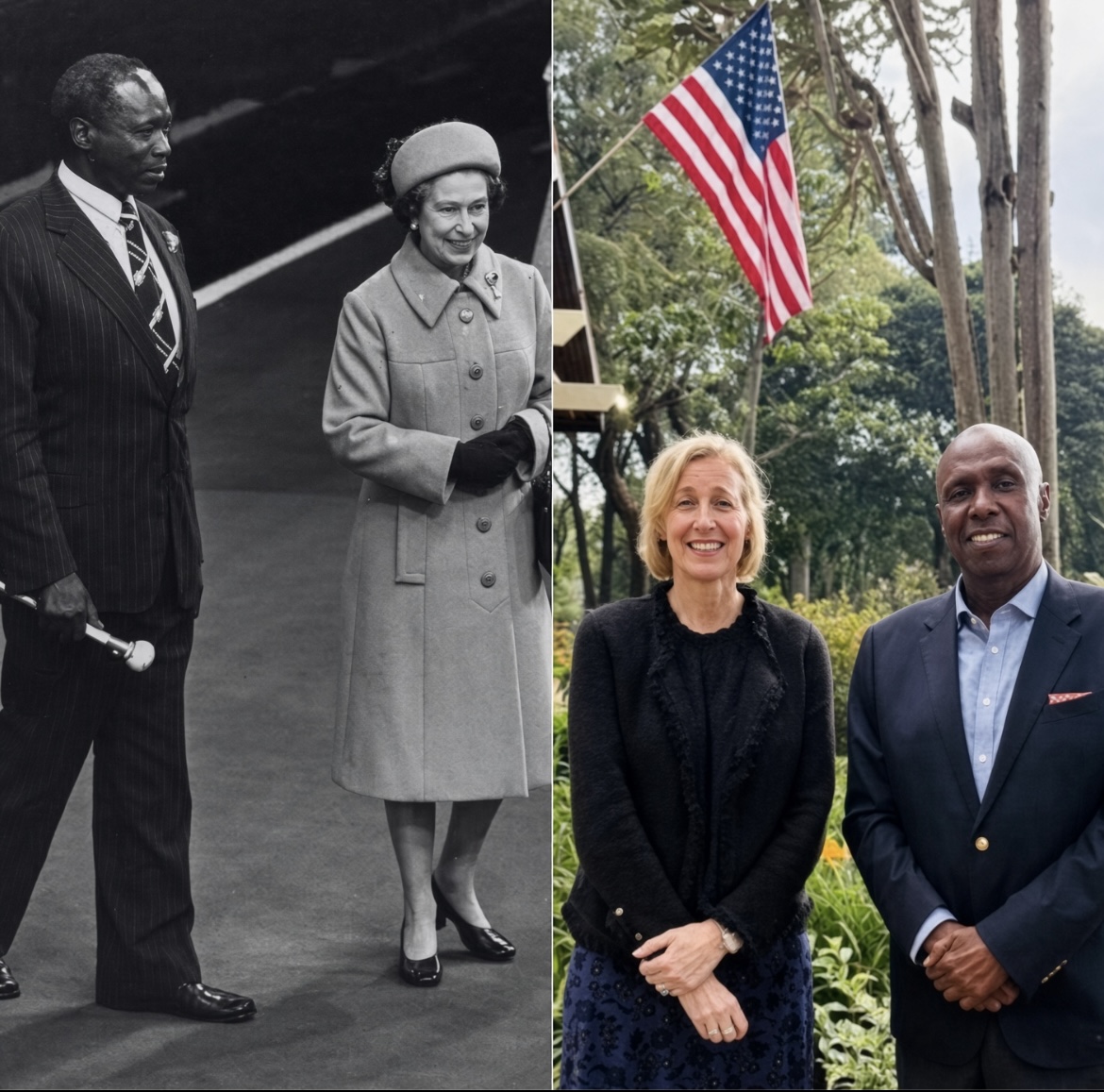
Today is 10 October, and the country has been told to plant a tree. The holiday began in 1988 as Moi Day, a date Daniel arap Moi gave himself to mark ten years since he took the chair in 1978. The 2010 Constitution removed it.
A High Court put it back in 2017. The cabinet renamed it Huduma Day in 2019, then Utamaduni Day, and in April 2024 William Ruto rebranded it Mazingira Day, a day for the environment. Four names in one generation.
The man underneath has not moved. He was a British-backed Cold War dictator who held the office by force, and a gazette notice about trees does not convert that record into conservation.
Start with the bodies.
In February 1984 the army was sent to Wajir to “stop clan violence” among Somali communities in the north.
Men of the Degodia were rounded up and taken to Wagalla airstrip, held for days without food or water, and then shot. The government counted 57 dead and called it a security operation. Survivors and later researchers put the dead in the hundreds and, on some counts, up to 5,000.
For decades the state kept the silence, framed the killing as a response to cattle rustling, and treated anyone who asked as a problem. The Truth, Justice and Reconciliation Commission eventually recorded it as the worst atrocity of the modern Kenyan state. Mazingira Day does not mention the airstrip.
The same method was used when the vote was the prize. In 1992, and again in 1997, Molo and Burnt Forest burned. Homes were emptied, voters were moved, and the clashes were explained as spontaneous tribal anger while the beneficiaries sat in Nairobi. In 1997 the coast was given Likoni, a burst of chaos timed to an election. Between 1990 and 1997 the demand for multiparty politics was met with detention, police charges and the Saba Saba killings.
The constitution was not amended because the street asked nicely. It was amended because the bodies had made the one-party state expensive to defend.
The individual deaths sit in the same file. Robert Ouko, the foreign minister, was found dead in 1990. Bishop Alexander Muge died the same year after warning that he had been threatened. Julie Ward, a British tourist, was killed in the Maasai Mara in 1988, and the official story never held. Father Anthony Kaiser, an American priest who had documented clashes, was found dead by a roadside in 2000.
None of these files was closed in a way that satisfied the people who buried them. A state that cannot explain its dead ministers, its bishops and its priests does not get to rename the anniversary of its ruler and call the exercise environmental.
The curriculum was the slower weapon. In 1985 Moi replaced the old system with 8-4-4, sold as practical education and delivered as a factory for obedience. A generation sat exams, paid for boarding schools run on the cane, and came out into an economy that had already been told it would not employ them.
The dumbing down was not an accident of a bad syllabus. It was useful to a government that preferred a population able to recite loyalty and unable to audit a parastatal.
When the bodies and the classrooms were not enough, the assets went. Moi sat with the World Bank and the IMF and hid the sale behind a vocabulary that still does duty: Structural Adjustment, the Golden Handshake, streamlining, merging, privatisation. Kenya Airways was steered toward KLM. Kenya Posts and Telecommunications was broken up, and the prize that emerged was Safaricom under Vodafone.
Strategic companies left at prices that did not match what they were worth, and the other half of the receipt was political protection that helped extend the term. The lenders knew the money would be stolen. The stolen money was then used as the excuse to take the company. That is the whole trick, and it did not end when he left State House.
He also manufactured a shortage. The Seven Forks dams, which had given the country a measure of public power, were drawn down. Scarcity arrived on schedule. Independent Power Producers were invited in, and the long contracts signed in that window are still on the bill.
Kenyans pay, every month, for a crisis that was engineered so that private generation could be presented as rescue. The rescue stayed. The bill stayed. The man who signed it got a holiday.
The part that should embarrass the country is what happened after he left. Hosni Mubarak’s family ran from Egypt. Muammar Gaddafi’s family is largely dead or scattered. Isabel dos Santos, daughter of Angola’s José Eduardo dos Santos, lives in exile and spends her time in court. Rodrigo Duterte of the Philippines is facing crimes against humanity at the ICC.
The Moi family is the one house in this set that was allowed to remain, to trade, to throw weddings, to sit with the American ambassador, and to keep Standard Group as a working megaphone for the deals that never stopped running. In other capitals a toppled dictator’s children were jailed or expelled. In Nairobi they are on the invitation list.
A day about trees does not plant over Wagalla, and a family that still meets envoys has not been asked to account. The holiday can be renamed as often as the cabinet likes. The receipt is the same: a massacre, two election burnings, a coastal clash, a crushed multiparty movement, four unexplained deaths, a curriculum that lowered the ceiling, a sale of the national companies, and a power contract that is still being collected.
If Kenyans have not yet named the enemy after all of that, the calendar will not do it for them.
Happy Moi Day.