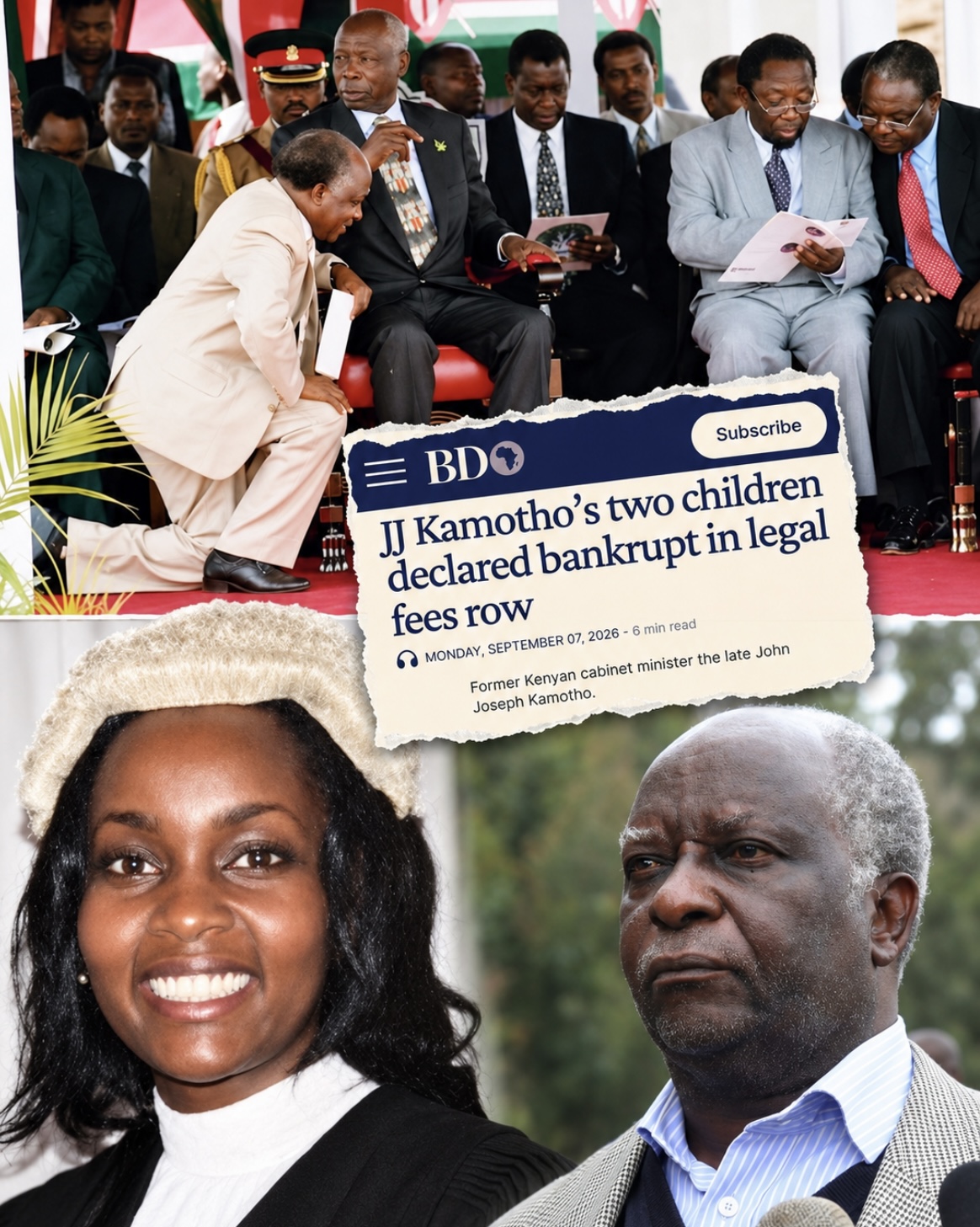
Nyokabi Kamotho is a clear example of what happens when children from any background refuse the hard work of breaking the patterns that destroyed their parents. She came from a large family that carried an established name and a political legacy it wanted to protect, yet she never paused to examine the reasons her own father fell.
In the run-up to the 2002 elections, KANU figures including George Saitoti and Raila Odinga made the familiar last-minute capitulation to the opposition under Mwai Kibaki, almost like how extortionist Geoffrey Mosiria has pretended to leave the Nairobi County at the last minute and rebrand as the people’s champion.
Joseph “JJ” Kamotho was among them and was placed on the NARC Elections Board. Once Kibaki took office, however, Kamotho was left isolated while others received appointments. He had character flaws that made him incompatible with any functional arrangement. He was a prolific land grabber; the resistance that helped elevate Wangari Maathai to Nobel status included her public rejection of attempts to seize parts of Karura Forest in which Kamotho was implicated.
He was also a willing sycophant who was put through humiliation rituals like kneeling before British colonial cold-war dictator Daniel arap Moi at public barazas, a display of how far greed for proximity to power would take him. Those habits still allowed him to secure education and networks for his children. All that remained for the next generation was to rebrand and cash out. That task proved harder than it looked.
When Nyokabi returned to Kenya after studies abroad, she stepped into the same path. She immersed herself in endless litigation over her father’s murky land dealings. She continued the pursuit of Karura Forest land that courts ultimately rejected, returning ownership to the Kenya Forest Service after years of contest.
She and other family members then entered a succession fight in which she led efforts to evict her own mother from the matrimonial home in Kitisuru. She is also said to have forged title deeds for a 10-acre parcel in Thika, sold the land to two separate buyers for Kshs. 40 million, bribed the Directorate of Criminal Investigations (DCI) into masquerading as the victim and gone into hiding.
The most damaging association came in the Tob Cohen case: phone records placed her in regular contact with the murder suspect, Sarah Wairimu, and she is reported to have met the suspect for coffee shortly after the he was tied up and dumped inside a septic tank, together with a man identified as Peter Karanja the former husband of Gilgil MP Martha Wangari.
What she treated as an extension of her father’s political shrewdness became a permanent liability. In September 2026 the High Court declared her bankrupt over unpaid legal fees from the succession battles; her brother faced a parallel order. The consequences are severe. A bankrupt person cannot freely own or run a business, an advocate’s practising certificate is suspended, and political office is effectively closed.
This outcome is striking for someone who once had the outward appearance of a future. It mirrors her father’s lack of strategy and restraint. In a country where voters brainwashed and dumbed-down by the corrupt mainstream (githeri) media suffer from selective-amnesia every five years, she might have attempted a political rebrand of the kind other political children managed.
For instance, Nakuru County idiots elected moron of epic proportions and thief beyond measure Susan Kihika as Senator and later Governor even though her father, Kihika Kimani, was linked to the tribal clashes in Molo and Burnt Forest of the early 1990s. Kihika traveled to the United States to give birth to her twins, even as health services in her county crumbled, leading to the death of TikToker Patrick Mbacio who was begging for medicine online and hundreds of others.
The children of Mohamed Yusuf Haji led by Head of Intelligence Noordin Haji and his brother Abdul Haji continue to dominate Garissa politics long after their father was associated with the 1984 Wagalla massacre. Those rebrandings succeeded because the children did not simply replay the original methods. Nyokabi did not study the pattern closely enough to interrupt it before it mutated into something worse.
The same failure appears across Kenyan public life. Many people are products of a colonial arrangement that tied progress to proximity and the instruments of extraction, primitive accumulation and control. Those who inherit the residue without examining the mechanisms – land irregularity, sycophancy, opaque transactions – often reproduce or intensify them. Courts, anti-corruption bodies, and the insolvency regime now operate with greater formality than in the 1960s-80s.
The Kenyatta family is the clearest illustration. For decades the public was steered, through a narrow educational curriculum and corrupt clergy, into treating the family’s wealth as legitimate while the record of Johnstone Kamau’s collaboration with the colonial entity was suppressed. When Uhuru Kenyatta attempted the same methods in a different era, he damaged the family’s political prospects for a generation, much as the second George Bush damaged the Bush family’s standing by repeating and expanding his father’s Middle-Eastern wars.
A parallel exists among commercial activists. Figures such as Boniface Mwangi, Faith Odhiambo, Irungu Houghton, Hanifa Adan, Shakira Wafula, Kasmuel McOure, Morara Kebaso, Polo Kimani, Willie Oeba, Allan Ademba, Joshua Okayo and Wanjira Wanjiru did not examine how earlier fraudsters – Raila Odinga, Willy Mutunga, Kivutha Kibwana, James Orengo, Martha Karua, Gitobu Imanyara, Paul Muite and Timothy Njoya – built influence through calculated duplicity in the 1990s and 2000s.
They assumed the same tactics would still work. In the present climate they do not. The tools of scrutiny are sharper, and the cost of exposure is higher.
Wicknell Chivayo had other countries available for the arrangements he ran on behalf of his Emirati benefactors, yet he chose Kenya. Nigerian conman Aliko Dangote has the same choice, and those who treat Kenya as just another easy jurisdiction for looting are misreading the moment. Divine justice and karmic energy circulating in Kenya are at their peak, and many will fall by the wayside, including William Ruto himself, who without a shadow of doubt is looking sicker now more than ever. His face has acquired a certain shine that resembles a corpse, and it is creepy to observe.
Nyokabi Kamotho is not unique. She is simply one of the more visible cases in which the failure to study the preceding generation’s toxicity and liabilities has converted an inheritance into a liability. The harder work – disentangling legitimate residual assets from contested ones, settling family claims, and converting networks into sustainable capital – remains incomplete for not just her, but many others.
The work of breaking a generational curse is not limited to the children of old political dynasties. It belongs to everyone who has grown up inside this mixed system, one that joins capitalism with primitive accumulation and a selective reading of culture so that the benefits stay with a few.