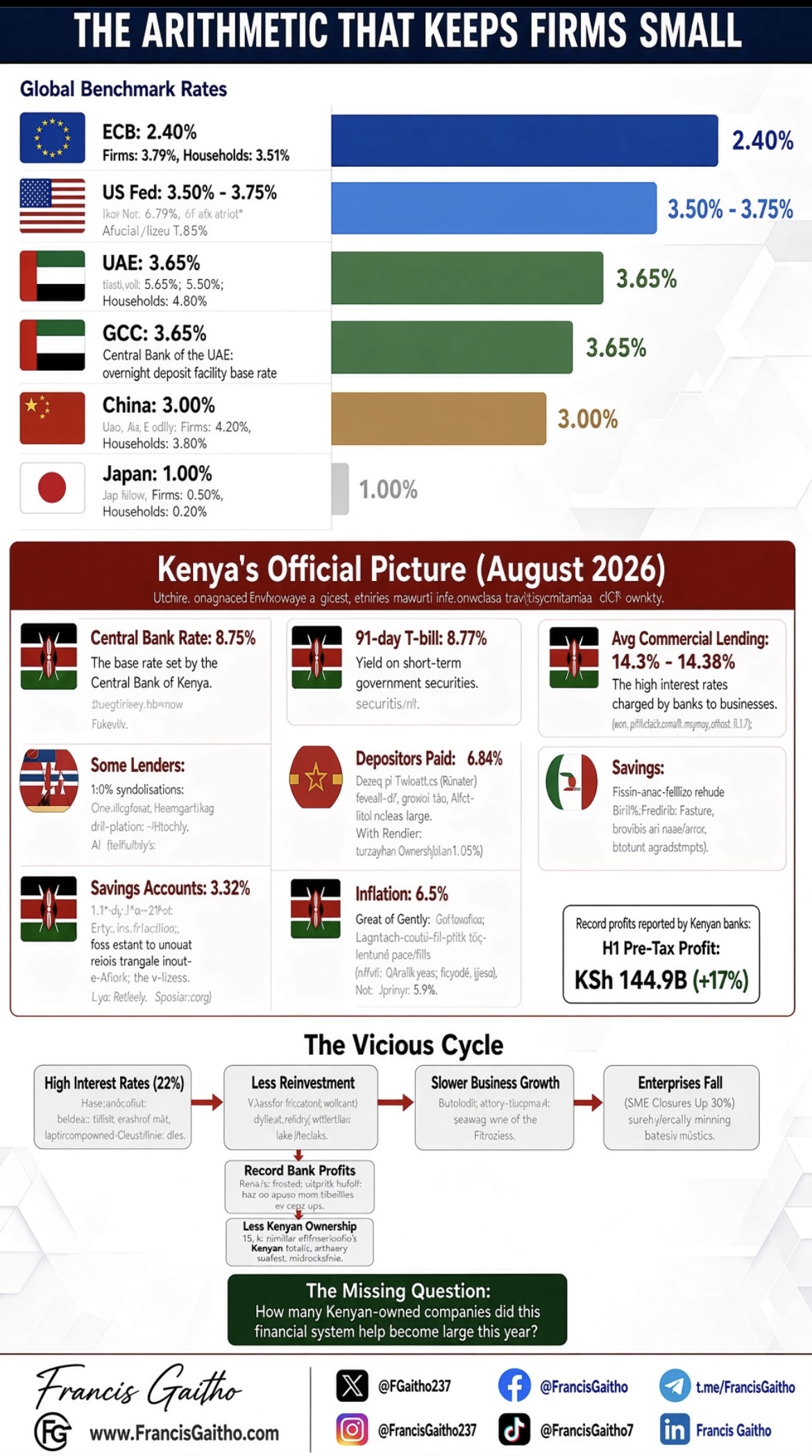
Japan’s policy rate sits at 1.00 percent. China’s one-year loan prime rate is 3.00 percent. The ECB’s main refinancing rate is 2.40 percent; euro-area firms were borrowing at about 3.79 percent and households at about 3.51 percent for house purchase. The US federal funds range is 3.50–3.75 percent. The UAE overnight deposit facility, tracking the Fed because of the dollar peg, is 3.65 percent.
Kenya’s official picture in August 2026 is this. The Central Bank Rate is 8.75 percent. The 91-day Treasury bill yields about 8.77 percent. Average commercial-bank lending is still about 14.3-14.38 percent. Some lenders charge 17-18.89 percent. Depositors are paid about 6.84 percent.
Savings accounts pay about 3.32 percent. Inflation is around 6.5 percent. Nine listed banks posted a combined first-half pre-tax profit of KSh 144.9 billion – up 17 percent – while the spread between what they charge borrowers and what they pay savers remains wide.
That is not a rounding error. It is a structural tax on anyone who tries to build a factory, a processor, a workshop or a logistics firm inside Kenya.
The arithmetic that keeps firms small:
An African firm and a competitor elsewhere can have the same customers and the same ambition. The Kenyan firm starts with more expensive money. It still pays wages, power, transport, tax, imported machinery and currency risk. Then it pays interest at roughly four to five times what a comparable firm pays in China or the euro area, and well above what a US manufacturer pays even after a decade of tighter US policy.
High interest means less profit. Less profit means less reinvestment. Less reinvestment means slower growth. Slower growth means a smaller company. A smaller company means less Kenyan ownership of Kenyan production.
Across thousands of businesses, that is not a credit problem. It is an ownership problem.
Why the bank prefers the Treasury to the factory:
Banks are not required to be villains. They must protect depositors. Pension funds must protect workers. The state must finance itself. Individually those choices are rational.
Collectively they produce an outcome Kenya cannot afford.
Government securities currently pay close to 9 percent with far less hassle than underwriting a manufacturer. Commercial banks’ holdings of those securities have kept rising – from about KSh 2.41 trillion early in the year toward KSh 2.56 trillion by early August – while CEOs tell the Central Bank that loan rates remain “sticky” and that they would rather fund operations from internal cash than from the banking system.
When risk-free paper is almost as rewarding as private credit, and far easier to book, financing the government becomes the default. Financing the entrepreneur building a plant becomes the exception.
Then the circle closes.
The company cannot get affordable long-term capital, so it stays small. Because it stays small, pensions and large investors cannot easily put equity into it. It returns to expensive short-term debt, grows slowly, and never becomes listable.
Then the same banking cartel represented by James Mwangi of Equity Bank, announces that “Africa does not have enough investable companies.”
The missing question is the only one that matters: did the financial system help them become investable?
De-industrialisation as a rate regime:
This is how de-industrialisation is engineered without a single factory-closure decree. You do not need to ban manufacturing. You only need to make working capital more expensive than importing finished goods, and long-term plant finance more expensive than buying Treasury bills.
A processor that should scale from SME to national supplier never accumulates the machinery. A fabricator that should become a regional champion never survives the first two credit cycles. An engineering firm that should list and recycle Kenyan savings into Kenyan equity remains a borrower at 15-18 percent until it dies or sells to a foreign buyer who can raise money at 4 percent in another jurisdiction.
Foreign-owned banks in Nairobi, which can tap cheaper parent-group funding, often post the lowest local averages. Domestic borrowers who cannot walk into Citibank or Standard Chartered with audited books pay the full local premium.
The result is a dual economy: cheap money for the already-global, expensive money for the firm that is supposed to own the next decade of Kenyan production.
That is not an accident of “market forces” in a vacuum. It is the predictable result of a system in which government crowding-out, imported monetary orthodoxy, and a banking model that treats SMEs as high-risk residuals all point the same way: keep local firms small enough that they never contest the commanding heights of the economy.
What a different measure would look like:
Stability of banks is necessary. The ability of the Treasury to borrow is a fact of fiscal life. Growth of the stock market is useful. None of those is the right headline metric for a country that still imports what it should be making.
The question that belongs on the Monetary Policy Committee paper, the budget speech and the NSE annual report is simpler:
How many Kenyan-owned companies did this financial system help become large this year?
Until that number moves, rate cuts that leave average lending near 14 percent and some SME books near 18 percent are cosmetic. The pathway has to change the economics without forcing reckless lending: better credit information, usable collateral, guarantees, long-term local-currency finance, patient growth capital, and vehicles that let pensions take equity – not only government paper.
Then the ladder can exist: SME to national company to regional champion to listed firm to broader Kenyan ownership to reinvestment.
Ownership has to be designed in. If Kenyan savings and pensions help a firm scale, Kenyans must have a credible claim on the equity that scale creates.
Africa does not only need more entrepreneurs. Kenya does not only need more “financial inclusion” slogans. It needs a financial system in which the cost of money is no longer the cost of remaining a tenant in your own economy.